
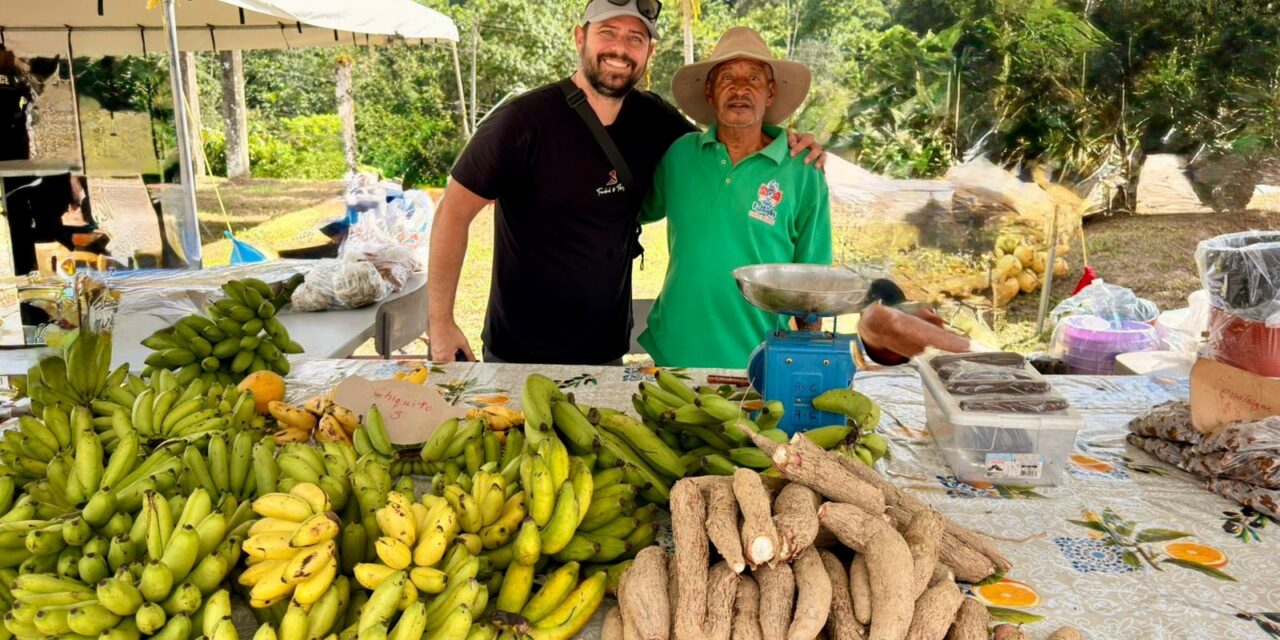
Why Should I Buy Local?
AMBITION | Business & Markets | Financial Literacy Series
“Buy local” is one of those phrases that gets thrown out during tough economic times, discussed in the media, mentioned in budget speeches, and then largely forgotten when people get to the supermarket and see that imported products are cheaper or more popular.
So instead of giving you a lecture about patriotism, let us have an honest conversation about what actually happens when you spend your money on local products versus international products, why it matters more than most people realize, and when it genuinely makes sense versus when it does not.
Where Does Your Dollar Actually Go?
When you spend $100 at a locally owned business in Trinidad, a significant portion of that money stays in the local economy. The business owner pays their staff, who live in Trinidad and spend their wages in Trinidad. They pay rent to someone locally. They buy supplies from local distributors. They also bank with local financial institutions like Republic Bank or First Citizens. They pay taxes to the government, which in turn fund roads and schools and hospitals. That money circulates.
When you spend the same $100 on an imported product, a much larger portion of that money leaves the country almost immediately. It goes to the overseas manufacturer, the foreign shareholders, and the international supply chain. What stays here is relatively thin.
This is not an argument against imports. We import most of what we consume and that is not going to change. The point is simply to understand that the decision of whether to buy local products versus buying imported products has an economic consequence that goes well beyond your personal transaction.
The Multiplier Effect
Economists have a concept called “The multiplier effect.” It works like this: money spent locally tends to circulate through the economy multiple times before it eventually leaks out. Each circulation creates economic activity, supports employment, and generates tax revenue.
A dollar spent at a bakery in Port of Spain pays the baker, who pays for the flour manufacturer, who pays their staff, who buys school supplies for their children from the book shop. Each of those transactions supports a Trinbagonian household. The original dollar has done four or five times its original work before it eventually exits the system.
A dollar spent on a foreign products or online retailers outside of the country does one job: it pays for your item. Then it’s gone.
In a small economy like ours, this multiplier matters enormously. It is part of why economic downturns here tend to be self-inflicted: when people spend less locally, local businesses suffer, they cut staff, those staff members spend less, and the cycle feeds on itself.
The Employment Connection
This is perhaps the most direct reason to care about buying local, and it is one that hits close to home for most families.
The businesses that employ most Trinidadians are local ones. The supermarkets, the construction companies, the manufacturers, the service providers, the small mini marts. Even the large conglomerates like Massy Group and Agostini’s, which together employ thousands of people across distribution, retail, and services, are locally rooted businesses whose fortunes are tied to local consumer activity.
When local businesses thrive, they hire. When they hire, disposable incomes rise. When disposable incomes rise, other local businesses benefit. When local businesses struggle because spending has shifted overseas or to imports, the reverse happens, and it is ordinary employees and their families who feel it first.
Buying local is not charity to business owners. It is, in part, an investment in the employment conditions of the people around you, including people you know.
The Quality Argument Has Changed
One of the traditional objections to buying local was quality. For a long time, imported products were assumed to be better, more reliable, more sophisticated. And in some categories, that was true.
But that narrative has shifted considerably. Local food producers have improved dramatically. Local financial institutions like Guardian Group and Sagicor offer products and service levels that compare well with anything available internationally. Local professional services, in law, accounting, engineering, architecture, have always been strong. And in some areas, particularly food and creative industries, local products are simply better than anything you can import because they are made for this market, this climate, and this culture.
The assumption that foreign automatically means better is worth examining honestly. Sometimes it is true. Often it is not. And it is always worth checking before defaulting to an imported option on the basis of habit or prestige.
The Foreign Exchange Reality
Here is a dimension of the buy local conversation that does not get discussed enough in plain language: Foreign Exchange.
Trinidad and Tobago earns the vast majority of its foreign exchange, US dollars and other hard currencies, from energy exports. That foreign exchange is what allows us to import everything from food to cars to electronics to medicine. When energy revenues drop, foreign exchange becomes scarcer. The Central Bank manages the allocation, commercial banks ration it, and businesses that depend on imports find it harder and more expensive to operate.
Every time you choose a locally produced item over an imported one, you are, in a small way, reducing the pressure on that foreign exchange pool. When enough people and businesses make that choice consistently, it adds up to something real at a national level.
This is the practical logic behind why local substitution matters in an economy as import-dependent and foreign-exchange-constrained as ours.
Buying local is not just a lifestyle choice. In an economy as import-dependent as ours, it is a small but real act of economic self-preservation.
When Buying Local Does Not Make Sense
Let us be honest about the limits of this argument too. There are categories where local options genuinely do not exist at the scale or quality needed. We do not manufacture cars. We do not produce most of the medicines we need. We do not make most of the industrial equipment that our businesses rely on. In those cases, importing is not a choice, it is a necessity.
There are also cases where the price differential between local and imported is so significant that asking lower-income households to absorb it is genuinely unfair. The buy local argument cannot be used to justify protecting inefficient local producers at the expense of consumers who are already stretched.
The honest version of the case for buying local is this: where local options exist, are reasonably priced, and meet your quality needs, choosing them has a real economic benefit that goes beyond your individual transaction. Where those conditions are not met, the argument weakens considerably.
What You Can Actually Do
None of this requires a dramatic lifestyle overhaul. It starts with small, consistent choices.
When you are choosing between two comparable products and one is locally made, choose local. When you need professional services, consider local providers first before defaulting to international platforms.
When you are deciding where to bank or invest, know that institutions like First Citizens and the Unit Trust Corporation are locally anchored and their growth directly supports the local economy. When you eat out, mix in local restaurants and food vendors alongside the international chains.
These are not sacrifices but rather decisions with consequences. And when enough people make them with some awareness of those consequences, the aggregate effect on a small economy like ours is genuinely significant.
The economy is not something that happens to you. Every dollar you spend is a vote for the kind of economic environment you want to live in. That is worth thinking about.
This article is part of Ambition’s Financial Learning Path series, designed to help people in Trinidad and Tobago build real financial literacy from the ground up. It is educational content, not personalized financial advice.